
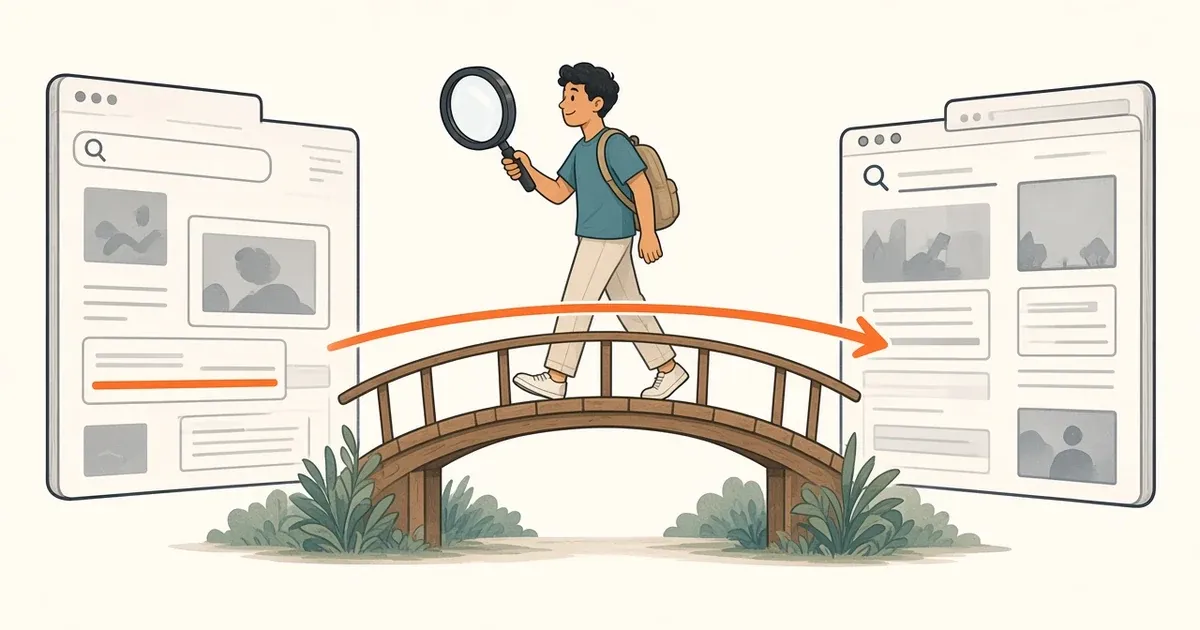
A backlink is an HTML hyperlink from another website that points to a page on your website. Search engines read a backlink as a sign that the target page deserves to rank.
Every backlink has three basic components. First is the source page, which is the URL where the link lives. Second is the destination page, which is the specific page on your domain receiving the visit. Third is the anchor text, which is the clickable text or phrase that labels the link. Search engines read these pieces together to understand the context of the link.
What you need to understand before tracking links
Before you review reports or try to collect links, you need to understand the distinction between raw backlinks and referring domains.
A referring domain is an independent website that links to your site at least once. If a regional news blog links to your guide fifty times across different articles, your site gains fifty backlinks, but only one referring domain.
Search engines place greater weight on citations from many distinct websites than on repeated links from a single source. A single blog running a link to your homepage in its global footer might generate hundreds of individual links overnight. That does not mean your popularity grew by hundreds of votes. Because of this, follow the count of referring domains over time, not raw link totals.
How to evaluate and count incoming links
When you monitor how other sites connect to yours, sort the data into clear categories so you know what the numbers actually show.
1. Separate individual links from referring domains
Always view your total links side by side with your referring domain count. If an audit shows many links from only a few domains, your link pattern is concentrated. Sitewide footers, blogroll sidebars, or automated aggregators can cause this. A healthier pattern shows a steady spread of referring domains where each domain contributes a few relevant contextual links.
2. Check the destination and anchor text
Look at where the links land. Do they point solely to your homepage, or do they reference deep pages such as product guides, original research, or technical explainers? When external publishers link naturally, they cite specific resources and use descriptive anchor text that explains the destination. Irrelevant or overly repetitive commercial anchors can signal low-quality link schemes.
3. Track new and lost domains over time
Sites gain and drop mentions as the web changes. Tracking your incoming links across 30, 60, or 90 days shows whether your editorial reach is growing or shrinking. When a referring domain disappears, check whether the source article was deleted or whether your destination URL broke and returned a 404 status.
For example, a hypothetical recipe site at example.com gets a backlink report that shows external mentions from several food publications. Because the report groups citations by referring domain, the team can easily see which publishers linked to their recipes without getting distracted by duplicated tag archive links.
Common mistakes when analyzing backlinks
Chasing raw link counts and misreading reports leads to wasted effort. Avoid these three mistakes:
- Equating high link counts with real growth: A sudden jump of thousands of links can come from one domain that repeats a link in a page template. It does not mean thousands of new people found your site.
- Treating proprietary scores as search engine grades: Third-party authority and spam numbers are internal estimates created by private tools. They help sort lists, but search engines calculate relevance independently using their own algorithms.
- Disavowing links without real evidence: Most sites never need a disavow file. Google says that in most cases it can assess which links to trust. Disavow when you see spam links you did not build, or after a manual action.
Questions about backlinks
What makes a backlink valuable for search rankings?
A valuable backlink comes from an established, topically related website where the link appears naturally inside the body text. The linking page should discuss topics relevant to your content, and the anchor text should describe the linked page accurately. Links that attract actual human clicks and direct readers to helpful resources carry more real-world value than hidden footer links or automated directory listings.
What is the difference between nofollow and dofollow links?
A standard dofollow link passes search engine signals to the destination page without special restrictions. A nofollow link contains an HTML attribute that tells crawlers not to associate their ranking signals directly with the target URL. Publishers use nofollow or sponsored attributes for paid placements, advertisements, and user-generated comments. Both types still bring direct referral traffic and brand awareness.
Can bad backlinks harm my website?
Casual spam links from random scrapers rarely harm a normal website because modern search engines recognize and ignore low-quality web noise automatically. Harm typically occurs only if a site deliberately buys artificial links at scale or runs manipulative schemes that trigger a manual penalty from search evaluators. In normal situations, you do not need to panic over everyday scraper domains.
How often should a small business check its backlink profile?
Checking once a month or once a quarter is plenty for most small businesses. That interval gives you enough time to spot broken URLs that lose incoming traffic, review new mentions from partners, and identify topics that other publishers naturally reference. Daily backlink monitoring is usually unnecessary unless you manage rapid public relations campaigns.
For a broader overview of how citations fit into your search strategy, read our backlinks guide for site owners.
For a fast look at a domain's estimated totals, try our free backlink checker. To see the referring domains of a tracked site, open check backlinks on Starter and above.
Keep reading